No-mask solar cells: Why 250% efficiency gains aren’t the real story
No-mask solar cells: Why 250% efficiency gains aren’t the real story📷 Source: Web
- ★Laser-assisted MOCVD skips masks and patterning
- ★0.65% efficiency now, but 250% under concentration
- ★Indium islands on molybdenum glass cut production steps
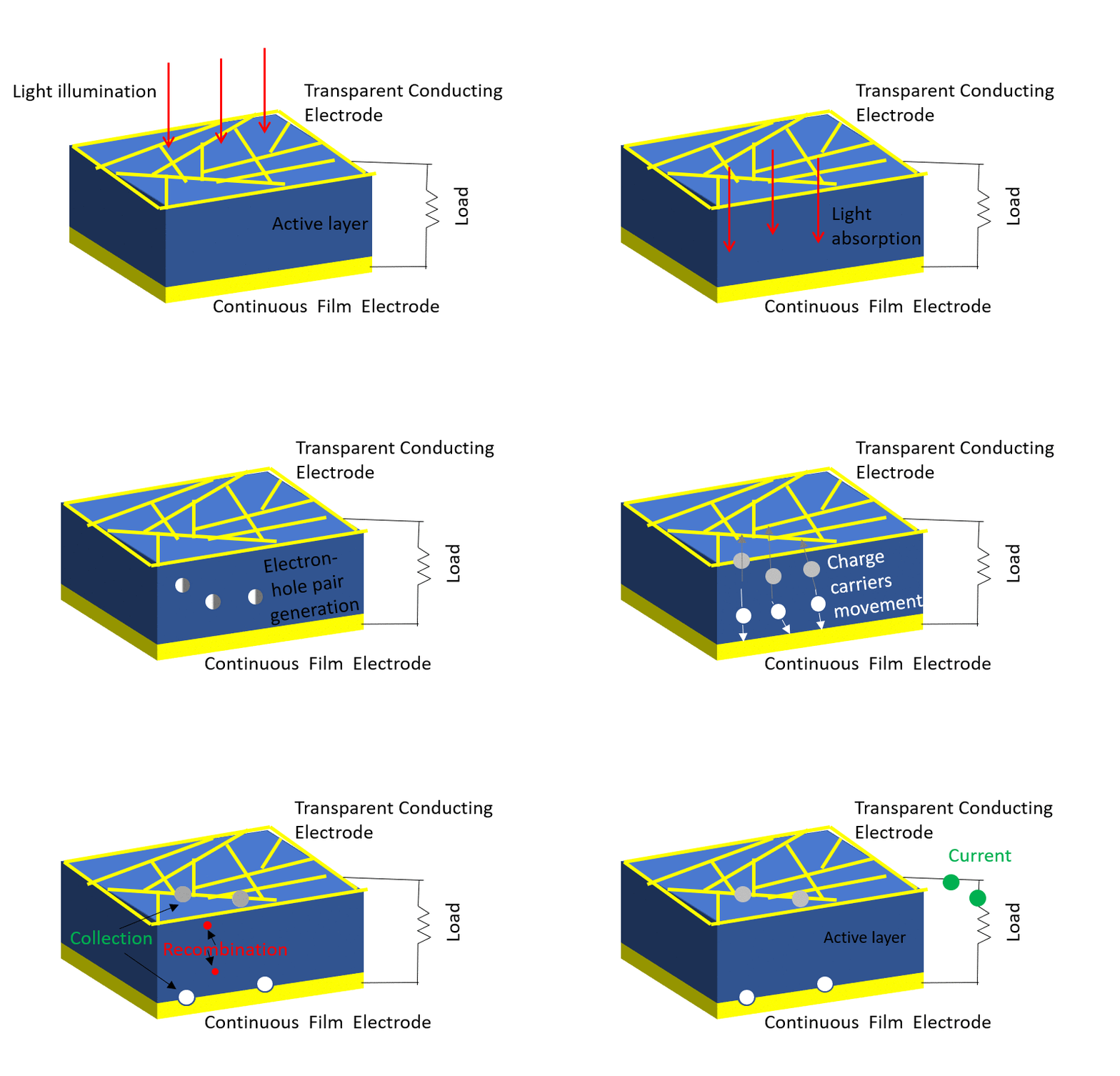
German researchers just proved you don’t need masks or lithography to build solar cells. Their CuInSe₂ micro-concentrator modules—grown via laser-assisted metal-organic chemical vapor deposition (MOCVD)—form indium islands directly on molybdenum-coated glass, eliminating two of the most finicky steps in traditional fabrication. The result? A process that’s simpler, not a cell that’s (yet) better: unoptimized modules hit just 0.65% efficiency under standard sunlight.
That number isn’t the point. Under concentrated illumination (think lenses or mirrors focusing light onto tiny cells), efficiency jumped 250%—a reminder that micro-concentrator designs live or die by their behavior under pressure, not their baseline specs. The real innovation here is the how: by skipping patterning, the team sidesteps a major cost and complexity hurdle in CIGS solar production, where mask alignment and material waste eat into margins.
For an industry obsessed with percentage-point efficiency gains, this is a quiet rebellion. It trades headline-grabbing metrics for a workflow that could, if scaled, make micro-concentrator cells viable outside niche applications. The catch? ‘If scaled’ is doing a lot of work in that sentence.
The workflow shift hiding behind modest efficiency numbers📷 Source: Web
The workflow shift hiding behind modest efficiency numbers
The immediate market impact is negligible. At 0.65% efficiency, these cells wouldn’t power a garden light, let alone a grid. But the method’s simplicity—depositing indium islands without masks—hints at a future where concentrator photovoltaics (CPV) could shed their reputation as high-maintenance curiosities. Traditional CPV systems require precise optical alignment and cooling; this approach bakes some of that precision into the fabrication itself.
There’s a precedent for this kind of tradeoff. Perovskite solar cells, now flirting with 33% efficiency in labs, spent years as a scientific darling with no path to production. The German team’s work flips the script: start with a manufacturable process, then optimize performance. It’s a gamble that the solar industry’s next bottleneck won’t be efficiency, but repeatability—and that investors might finally reward simplicity over specs.
Still, the unanswered questions loom. Without a named institution or funding details, it’s unclear who’s betting on this beyond the lab. And while 250% gains under concentration sound impressive, real-world CPV systems face durability and tracking challenges that no fabrication breakthrough can solve alone.