Autonomous drone swarms: Ukraine’s uncharted AI battleground
Autonomous drone swarms: Ukraine’s uncharted AI battleground📷 Published: Mar 25, 2026 at 12:00 UTC
- ★Engineer’s vision of AI-controlled drone swarms as warfare’s next phase
- ★Autonomous submarines as potential drone launch platforms
- ★Civilian tech’s dual-use dilemma in military AI escalation
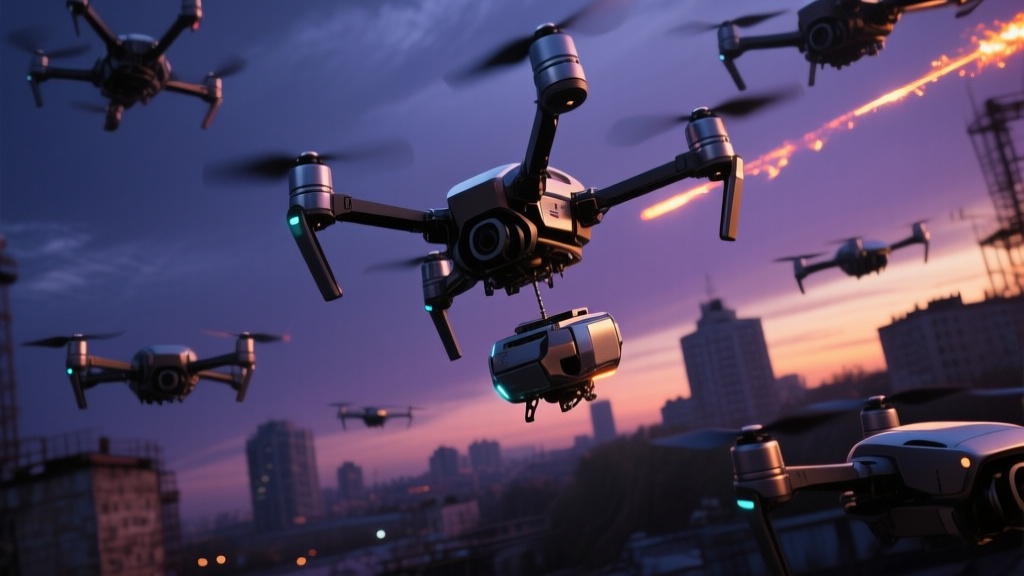
In late December 2025, as Kyiv braced for another wave of missile strikes, Yaroslav Azhnyuk—a Kyiv-born engineer and former CEO of California-based Petcube—painted a picture of warfare’s near future that reads less like speculation and more like an inevitability. His scenario: swarms of autonomous drones deploying other autonomous drones mid-flight, all coordinated by AI agents under human oversight, but operating at speeds and scales that render traditional defense obsolete. "How do you protect from that?" he asked during a conversation spanning Kyiv and London, published by IEEE Robotics. The question isn’t rhetorical. It’s operational.
Azhnyuk’s vision isn’t sci-fi posturing; it’s an extrapolation of trends already unfolding. Ukraine’s war has become a proving ground for drone-based electronic warfare, where off-the-shelf quadcopters and FPV drones now dictate battlefield tempo. But the leap to full autonomy—where machines select targets, evade countermeasures, and self-coordinate—marks a threshold. This isn’t about replacing soldiers with robots; it’s about compressing the OODA loop (observe, orient, decide, act) into milliseconds, a pace no human-led system can match.
The implications stretch beyond Ukraine. Azhnyuk’s mention of autonomous submarines surfacing off coastlines to discharge drone swarms isn’t idle musing. The U.S. Navy’s Ghost Fleet Overlord program and Russia’s Poseidon drone already signal a shift toward uncrewed maritime platforms. The missing link? Scalable autonomy. If drones can swarm, why not their launchers?

The tactical shift where consumer hardware meets strategic autonomy📷 Published: Mar 25, 2026 at 12:00 UTC
The tactical shift where consumer hardware meets strategic autonomy
The dual-use dilemma here is acute. Petcube, Azhnyuk’s company, builds consumer pet cameras—hardware that, with minor modifications, could feed into the same supply chains now fueling Ukraine’s drone corps. This isn’t hypothetical: civilian tech has been repurposed for war since 2022, from Starlink terminals to DJI Mavics. The difference now is the layer of autonomy. When a drone no longer needs a pilot in the loop, the barrier between consumer gadget and weapon collapses.
What’s often overlooked in discussions of autonomous swarms is the logistical advantage. A single human operator could, in theory, oversee hundreds of drones, each making tactical decisions in real time. The bottleneck isn’t the AI—it’s the data links and electronic warfare resilience. Jamming a swarm’s communications might ground it, but distributed AI could let drones adapt mid-mission. That’s the threshold Azhnyuk’s scenario probes: the point where warfare transitions from networked to self-sustaining.
For now, full autonomy remains a tactical experiment. Ukraine’s ‘Baba Yaga’ drone unit still relies on human pilots, and Russia’s Lancet drones are semi-autonomous at best. But the trajectory is clear. The question isn’t if drone swarms will dominate future conflicts—it’s who will control the infrastructure that enables them, and whether the rules of engagement can keep pace.