India’s robotics giant: the video is neat, the factory is not
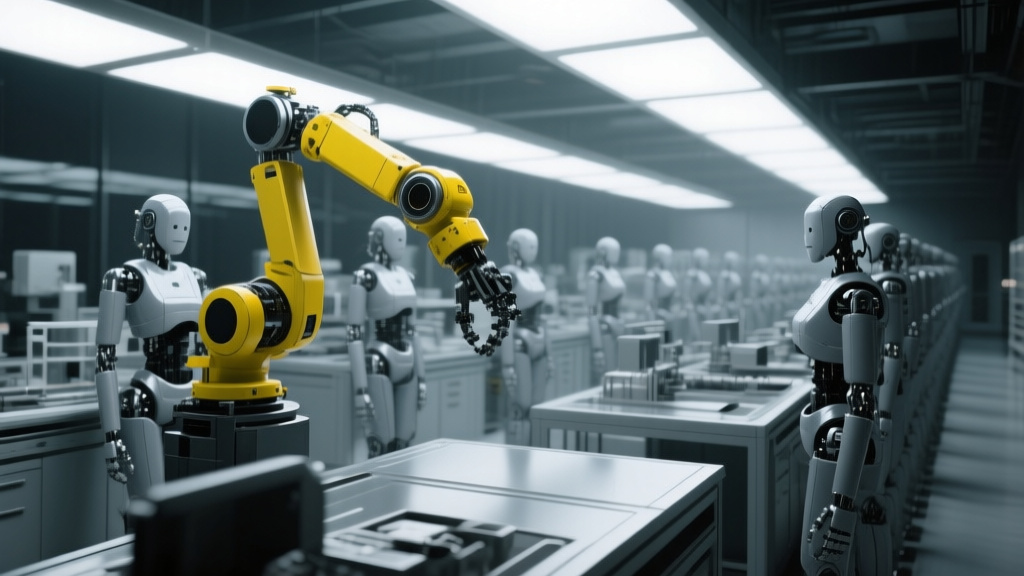
A sprawling, ultra-modern laboratory at RuntimeBRT, with matte silver and gunmetal grey robots lined up under bright, white clean-room lighting, deep📷 Photo by Tech&Space
- ★Spotless labs hide harsh deployment conditions
- ★Hardware limits absent in marketing demos
- ★No proof of large-scale industry adoption

RuntimeBRT’s latest YouTube showcase presents a flawless vision of India’s largest robotics company: pristine labs, fluid motion, and scripted scenarios. The video delivers exactly what tech brands want: polished choreography and aspirational framing. But the factory is not a studio. Dust-coated floors, humidity, unpredictable layouts, and long-duration stress are the conditions that decide whether a robot actually works.
The company claims market leadership, but evidence of widespread deployment remains elusive. Published case studies, third-party validation, or user testimonials are conspicuously absent. That is why it helps to compare the footage with IFR World Robotics and coverage like The Verge, which repeatedly point out how easily proof-of-concept gets mistaken for product readiness.
What is shown is impressive: precise articulation, sleek design, and seamless integration. What is missing is context. How does the system perform after 10,000 hours of continuous operation? What is the payload tolerance, and how quickly does performance degrade? Without those answers, the demo remains a demo.
The real deployment barrier: dust, humidity, and durability tests
The hardware limits are the real story. Battery life, sensing robustness, and environmental resilience decide whether a robot is viable outside a curated lab. Even a beautiful system can become expensive the moment it must survive dust, moisture, or people who do not follow the script.
Genuine use cases could include warehouse automation, precision agriculture, or hazardous material handling, but only if the platform can prove it handles real operating conditions. Scaling also means certification, reliability testing, and a cost structure buyers can live with. Wired has covered similar transitions where robotics hype finally had to answer to procurement.
So the practical reading is simple: this is a good demo, not a full answer. India’s robotics sector may be growing fast, but growth only becomes meaningful when the machines keep performing after the camera stops rolling.
The real deployment barrier: dust, humidity, and durability tests
The hardware limits are particularly telling. Battery life, sensing robustness, and environmental resilience are rarely addressed in promo materials, yet they determine whether a robot is viable outside a curated lab. For instance, IEEE Spectrum has documented how even established robotics firms struggle with real-world conditions like uneven surfaces or temperature swings. RuntimeBRT’s video offers no data on these factors, leaving potential buyers to guess.
Genuine use cases for this technology might include warehouse automation, precision agriculture, or hazardous material handling—but only if the system can withstand the conditions. The company’s website lists ‘scalability’ as a selling point, yet scaling requires overcoming certification hurdles, reliability testing, and cost efficiency, none of which are visible in the demo. Wired has covered similar cases where startups pivot from flashy videos to pragmatic pivots after encountering these roadblocks.
The real bottleneck may not be where the marketing points. It’s not about the robot’s elegance or even its technical specs—it’s about whether it can operate in the chaos of an actual warehouse, farm, or factory without requiring constant recalibration. Until that question is answered, the demo remains a high-budget illusion, a promise without proof.