VDA 5050 v3: a fleet standard or another layer of promise?

A bustling industrial warehouse aisle at night, bathed in sterile overhead lighting, where a forklift, an autonomous pallet jack, and a small📷 Photo by Tech&Space
- ★VDA 5050 Version 3
- ★Mixed Robot Fleets
- ★Scaling Mobile Robots

VDMA, the German association behind the standard, has announced Version 3.0 of the VDA 5050 communications framework. The goal is obvious: make mixed fleets of mobile robots easier to coordinate without every vendor inventing a private language. The Robot Report frames it as a scaling tool, and that is the right idea, but a standard only matters if the industry actually adopts it.
The upside is real. Better interoperability means less glue code, fewer custom adapters, and a cleaner way to orchestrate robots from different manufacturers. But standards do not eliminate hardware limits, and they do not erase the reality that the warehouse is messy. For more context, it is worth reading VDMA alongside practical integration discussions on ROS Discourse.
The deeper issue is that mixed fleets create more, not fewer, failure modes if they are not governed well. A robot that talks to the fleet manager is useful only if the fleet manager can survive battery variance, sensor mismatch, and uneven floors. That is why this release is better understood as infrastructure work, not product magic.
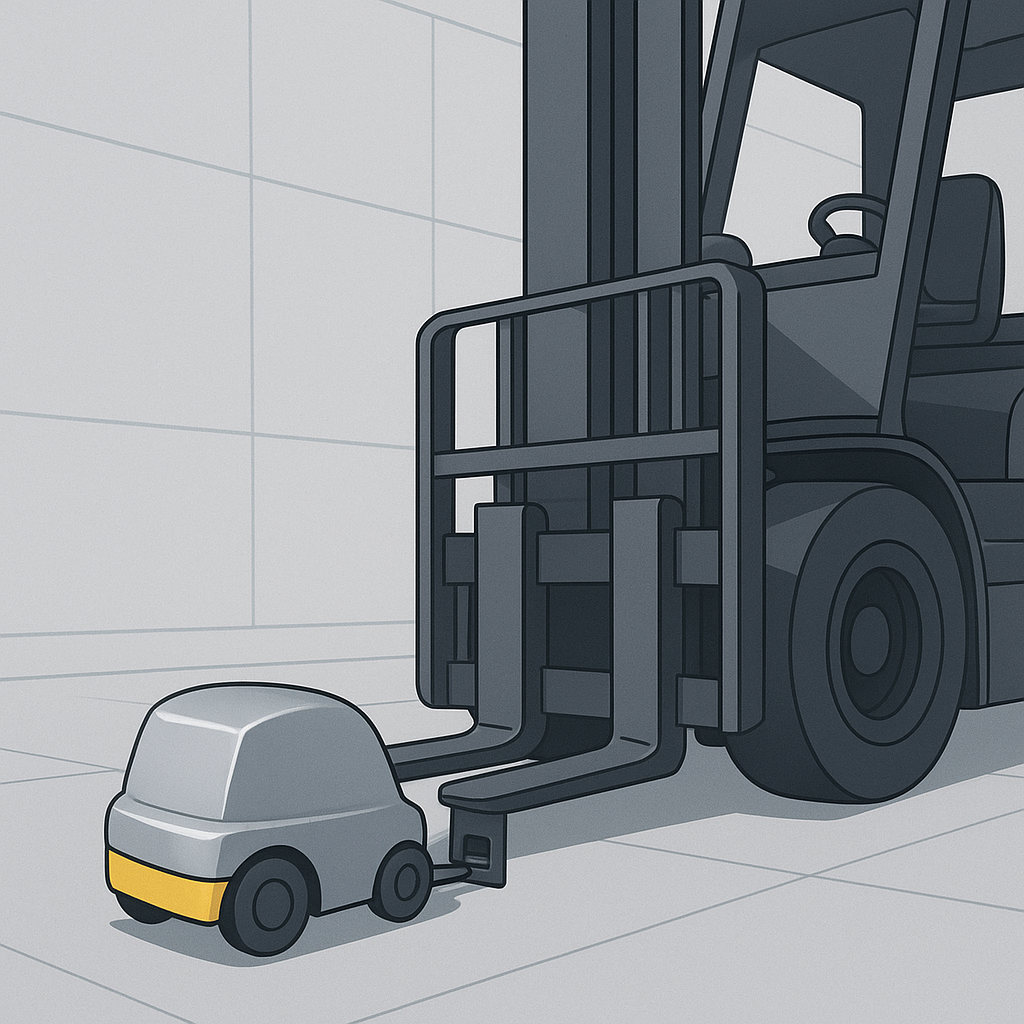
A comically mismatched scene in the same warehouse: a tiny, matte silver cleaning robot with warning-yellow bumpers attempting to dock with the📷 Photo by Tech&Space
From the lab to the warehouse: the gap between promise and practice
The real test begins when the standard meets certification. Safety rules such as ISO 3691-4 still apply, and every robot still has to prove that it can stop, reroute, or recover without turning a warehouse into a systems-integration project. Standards can reduce friction, but they cannot remove the need for field validation.
That is why VDA 5050 v3 matters most in the places where scale already hurts: depots, warehouses, and terminals that mix vendors and want fewer integration headaches. If the standard works there, it becomes genuinely useful. If it only looks neat in presentations, it remains another elegant document that the real world politely ignores.