Google’s AI Search Live goes global—but is it live yet?
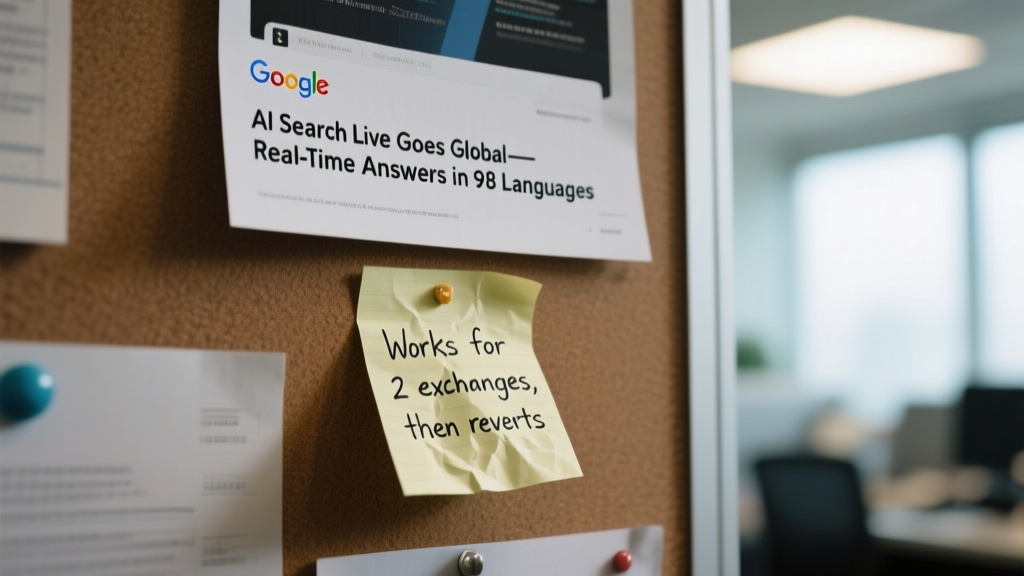
A split-screen composition of a Google press release on a sleek, dark matte background on the left, and a user's actual search result on a📷 Photo by Tech&Space
- ★98 languages added overnight
- ★Demo ≠ deployed product reality
- ★Bing, Meta already have similar tools
Google has flipped the switch on its AI-powered conversational Search Live, extending the feature to 200 countries and 98 languages in one fell swoop. The announcement, sourced from TechRadar, positions this as a major leap forward—yet the real-world rollout tells a more nuanced story.
For starters, the initial US launch was quietly tested with a limited audience, meaning most users outside the States have only just received access. The leap to 98 languages is technically impressive, but benchmarking real-world performance against Google’s own multilingual search suggests latency and accuracy vary wildly. Early reports from non-English users highlight inconsistencies, particularly in low-resource languages where the AI’s responses occasionally default to English or generate placeholder text.
Meanwhile, competitors like Bing and Meta have been running similar conversational AI features for over a year. Bing’s AI chatbot, for instance, supports 100+ languages and integrates directly into its search results, while Meta’s Llama-based tools have been available in multiple languages since 2023. Google’s move, then, feels less like a breakthrough and more like playing catch-up—albeit with the benefit of scale and brand recognition.

Google’s AI Search Live goes global—but is it live yet?📷 Photo by Tech&Space
The gap between Google’s press release and actual user experience
The hype filter here is critical: Google’s marketing emphasizes "real-time answers," but the reality gap between demo and deployment is widening. In the US, Search Live still struggles with multi-turn conversations, often defaulting to traditional search snippets after two or three exchanges. Extending this to 98 languages doesn’t address the underlying limitations—it just spreads them thinner.
For developers, the signal is mixed. Google’s decision to prioritize breadth over depth suggests a focus on market penetration rather than technical refinement. Open-source alternatives like Mistral and Llama remain popular on GitHub, with developers citing better control over latency and customization. The community reaction on forums like Hacker News and Reddit is skeptical, with many questioning whether Google’s AI is genuinely improving or simply being repackaged for broader distribution.
The competitive advantage, then, isn’t in innovation but in integration. Google’s dominance in search means even a flawed AI tool can gain traction by sheer volume of users. For competitors like Bing or DuckDuckGo, this is a pressure point—if Google can turn Search Live into a default habit, the bar for improvement becomes even higher. The real bottleneck isn’t the AI itself, but the infrastructure to deliver consistent, reliable results at scale.