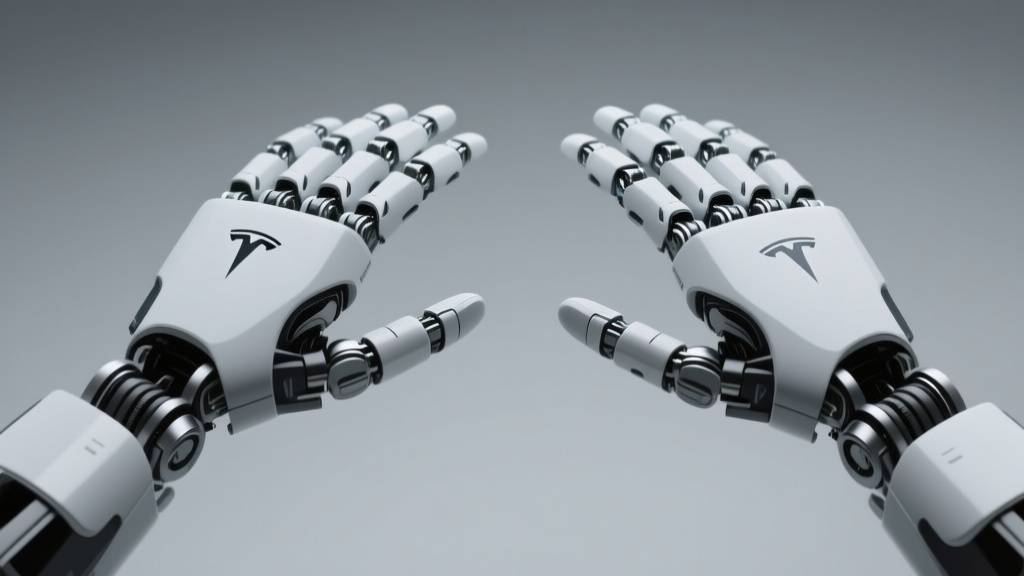
A top-down view of the Tesla Optimus Gen 3 robot's hands, with each finger and joint visible, demonstrating its 28 degrees of freedom, against a📷 Photo by Tech&Space
- ★Tesla Bot Gen 3 weighs 73kg, faster than Figure 03
- ★Real-world use cases still unproven beyond demos
- ★Competition heats up in humanoid robotics market
Tesla’s Optimus Gen 3 robot, unveiled in late 2024, enters the humanoid robotics race with a bold claim: it undercuts Figure AI’s Figure 03 on weight, speed, and dexterity. According to Tesla’s product page, the 73kg bot achieves a top speed of 5 mph—marginally faster than Figure’s 4.5 mph—and boasts 28 degrees of freedom in its hands alone, a step up from competitors. Yet, as with most Tesla announcements, the specs overshadow the substance: no third-party validation exists for tasks like complex manipulation or real-world navigation beyond choreographed demos.
The timing isn’t accidental. Tesla’s entry follows Figure AI’s $675 million funding round in February 2024, which valued the startup at $2.6 billion. Other players, like Agility Robotics’ Digit and Boston Dynamics’ Atlas, are also racing to commercialize humanoid robots, but Tesla’s brand and manufacturing muscle give it a unique edge—or so the narrative goes. The company’s press release emphasizes affordability and scalability, framing Optimus as a general-purpose worker, but the lack of pricing or timeline details raises questions about who this is actually built for.
For developers and enterprise customers, the question isn’t whether Tesla can build a robot but whether it can deploy one that works outside a controlled environment. Early leaked footage shows Optimus performing basic tasks like sorting objects, but Figure 03 has already logged hours in warehouses, while Tesla’s bot remains a prototype with no public pilot programs.
The real-world gap that specs don’t show
The industry’s reaction has been predictably split. Tech forums and robotics engineers on Reddit praise the hardware improvements—like Tesla’s custom actuators and neural net-based control—but criticize the lack of transparency around training data and failure rates. Meanwhile, Tesla’s legal troubles, including a Texas lawsuit alleging negligent hiring practices, provide a backdrop of skepticism. Even Tesla’s own safety record, like the Houston Autopilot incident where a vehicle nearly drove off an overpass, looms over the bot’s rollout.
For users—whether warehouse managers or potential homeowners—the real bottleneck isn’t speed or weight but reliability and integration. Humanoid robots require seamless software stacks to handle edge cases, something Tesla has struggled with in its automotive division. Competitors like Figure are already partnering with BMW and Amazon for pilot programs, while Tesla’s bot lacks even a formal beta program. The company’s pitch leans on its AI and manufacturing prowess, but the market demands proof, not promises.
The ecosystem effects extend beyond Tesla. If Optimus Gen 3 fails to deliver, it could set back public trust in humanoid robots altogether, especially for smaller startups relying on Tesla’s validation. Conversely, if Tesla pulls it off, the company could corner the market on affordable, mass-produced bots—a scenario that has regulators and competitors alike watching closely. For now, the specs are impressive on paper, but the user reality remains untested.