Telea promises better speaking, but still does not show why it matters
Telea promises better speaking, but still does not show why it matters📷 Published: Apr 16, 2026 at 10:20 UTC
- ★Telea targets a familiar human insecurity
- ★There is less product clarity than the slogan suggests
- ★The market is already full of stronger rivals

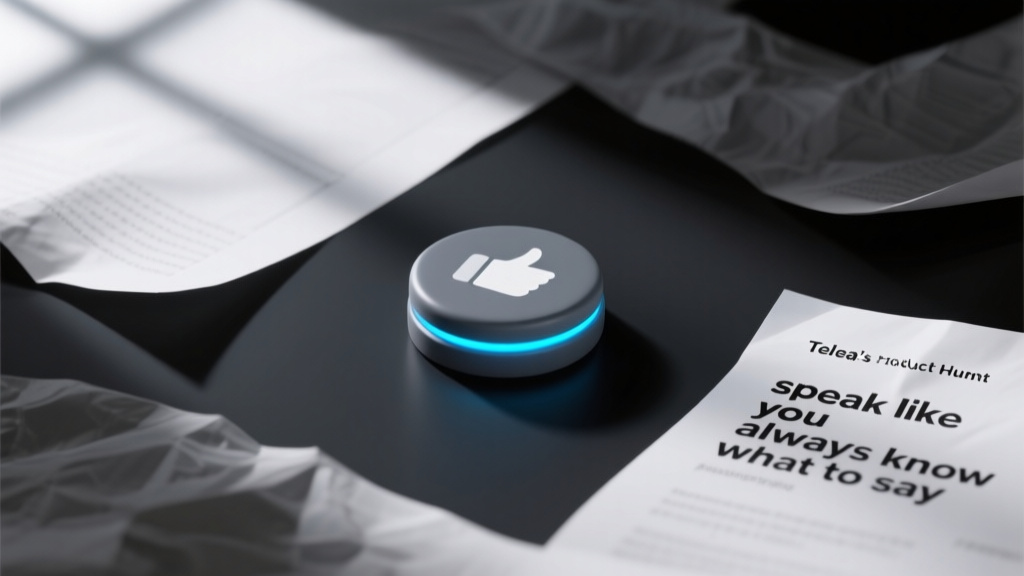
Telea arrived on Product Hunt with the kind of promise AI launches love: help people always know what to say. It is a smart pitch because it targets a real human weakness. Interviews, presentations, awkward pauses, and conversational self-doubt are all familiar pain points. The issue is that, at least for now, the pitch is clearer than the product.
That does not mean the category is pointless. Quite the opposite. There is already a market for tools that coach speaking, analyze delivery, and help users prepare for high-pressure conversations. Yoodli, Poised, Otter, and Descript all occupy pieces of that space. That is exactly why Telea has a tougher job than its launch copy suggests. If it wants to enter a crowded category, it has to show what it does better, more precisely, or more pleasantly than the tools that are already established.
So far, that case is not easy to see. The launch page contains enough promise to trigger discussion, but not enough detail for a serious user to judge its value. It is unclear how personalized the experience is, whether the tool works in real time, how well it handles accents and different contexts, or whether it is mostly a training assistant or a real-time conversational crutch. In other words, Telea looks like a product that understands the problem but has not yet demonstrated the solution.

When the problem is real but the product remains blurry📷 Published: Apr 16, 2026 at 10:20 UTC
When the problem is real but the product remains blurry
That matters because communication tools are unusually sensitive to the gap between demo appeal and actual habit. People may try an AI speaking coach once. They usually will not keep using it if the feedback feels generic, the latency becomes annoying, or the product adds stress instead of removing it. This is where a lot of speech-adjacent AI products fall apart: they are interesting enough for a product launch, but not useful enough to survive daily workflow reality.
There is another layer here too. When a startup promises more confident, smoother, or “better” speaking, it is not just selling software. It is selling emotional repair. That can be a lucrative category, but also a slippery one. If a product cannot clearly show where helpful assistance ends and generic confidence-as-a-service begins, users usually detect that quickly.
So the real story is not whether Telea’s launch copy sounds persuasive. It is whether the product can justify its existence in a category already crowded with tools that have clearer use cases and more operational proof. Maybe it will find a real niche. But until it does, the stronger lesson is about the market itself: AI still finds it very easy to turn familiar human insecurity into a polished product pitch.