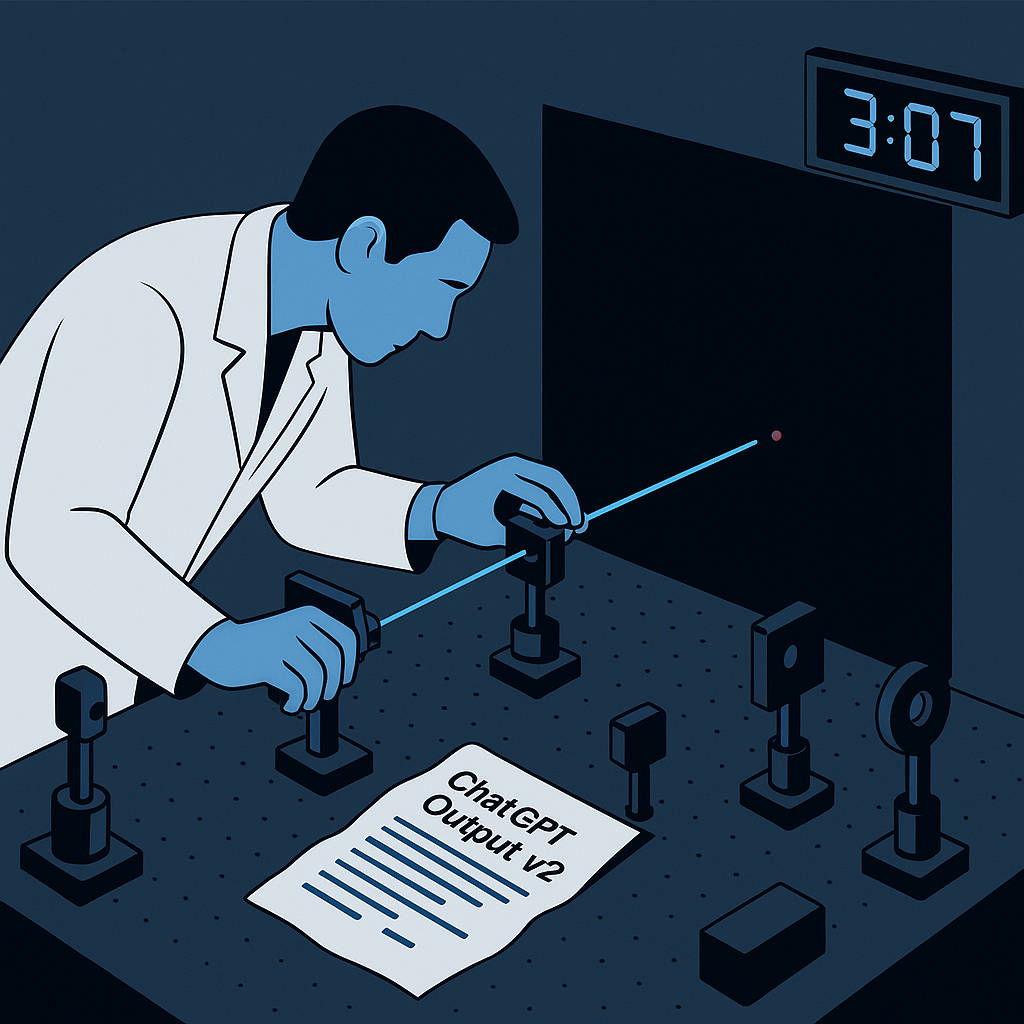
ChatGPT writes lab scripts—so what’s the catch?📷 Published: Apr 7, 2026 at 08:41 UTC
- ★LLMs cut lab coding barriers—no PhD in Python required
- ★Single-pixel camera demo hides real deployment gaps
- ★Automation vendors should start sweating
Researchers at arXiv just demonstrated what happens when you let ChatGPT loose on lab equipment: it writes functional scripts for a single-pixel camera and a scanning photocurrent microscope. No small feat—except the real test isn’t whether it can generate code, but whether that code survives contact with a grad student at 3 a.m. when the laser alignment drifts.
The paper’s core insight—that LLMs can lower the barrier for non-coders—is valid, but let’s not confuse a demo with a deployment. The setup required human oversight to validate outputs, debug edge cases, and handle hardware quirks. In other words, ChatGPT didn’t autonomously control the lab; it just wrote the first draft of the script.
This isn’t automation. It’s semi-automation with a fancy PR gloss. The hype machine will call it ‘AI-driven labs,’ but the reality is closer to a very smart intern who still needs supervision.
The competitive threat here isn’t to researchers—it’s to the lab automation software vendors charging six figures for proprietary scripting tools. If an LLM can generate 80% of the boilerplate, their value proposition just got a lot shakier.

The gap between ‘works in a paper’ and ‘works on Tuesday’📷 Published: Apr 7, 2026 at 08:41 UTC
The gap between ‘works in a paper’ and ‘works on Tuesday’
Early signals suggest the developer community is treating this as a curiosity, not a revolution. GitHub repos for lab automation tools like PyMeasure and QCoDeS aren’t exactly flooding with LLM-generated pull requests. The reason? Real labs need reproducibility, error handling, and documentation—things ChatGPT still hallucinates about when pressed.
The paper’s case study also reveals a telling detail: the LLM was used for customization, not core control. That’s a niche use case. Most labs don’t need bespoke scripts; they need reliable, validated workflows. Until LLMs can guarantee the latter, they’re a power user’s toy, not a standard tool.
Industry incumbents like Agilent and Thermo Fisher won’t lose sleep yet. Their lock-in comes from hardware integration and regulatory compliance—areas where LLMs have zero footprint. But for startups selling ‘no-code lab automation,’ the clock just started ticking.
The real bottleneck isn’t the AI’s ability to write code. It’s the lab’s ability to trust it.