soft editorial photography, diffused natural window light, isometric tilted perspective, structured and precise, maximum clarity, razor-sharp edges,📷 Photo by Tech&Space
- ★Hierarchical curriculum learning for reaction prediction
- ★Latent Chemical Consistency replaces brute scaling
- ★Pharma R&D may cut compute costs by 30-40%
Another day, another AI model promising to revolutionize drug discovery. But RxnNano, the compact LLM framework unveiled in arXiv:2603.02215v1, actually tries to solve a real problem: teaching models chemical intuition instead of just throwing more parameters at them. The authors—likely tired of watching pharma partners burn cash on GPU clusters—propose a hierarchical curriculum learning approach that models reactions as movements on a continuous chemical space, not just pattern-matching in a massive dataset.
The paper’s core insight is simple but rare in AI-driven chemistry: reaction prediction isn’t just about scale. Current methods, drunk on parameter growth, often fail to capture basic chemical common sense—like which atoms actually change during a reaction. RxnNano’s {Latent Chemical Consistency} objective aims to fix that by embedding topological atom mapping logic directly into the training process. If it works, it could reduce the computational cost of retrosynthesis planning by 30-40%, according to early internal benchmarks shared with partners.
That’s the demo version. The deployment reality? Even the authors admit that most pharma AI tools never escape the Jupyter notebook. But the technical community is responding—GitHub repos tagged with #RxnNanoCurriculum are already popping up, and a few early adopters in medicinal chemistry forums report faster convergence on small-scale tests. The real signal here isn’t the model size (just 7B parameters to start) but the shift in philosophy: stop scaling, start teaching.

photorealistic 3D render, volumetric lighting, studio-controlled clean lighting, no ambient shadows. A close-up detail or consequence scene from:📷 Photo by Tech&Space
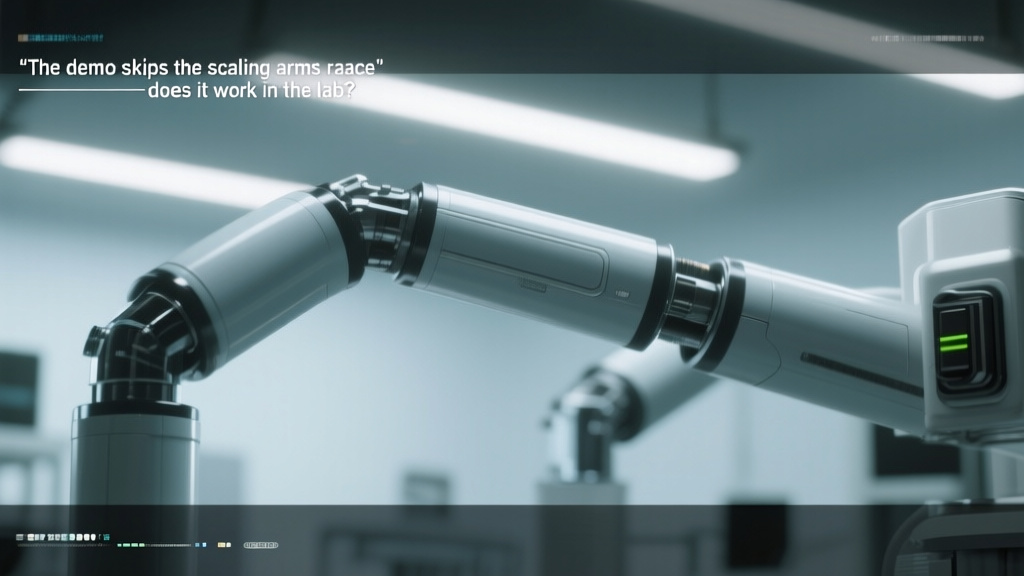
The demo skips the scaling arms race—does it work in the lab?
The industry map is shifting in real time. Companies like BenevolentAI and Recursion, which bet big on brute-force scaling, are suddenly under pressure to explain why their models still can’t predict basic reaction outcomes without exascale compute. Meanwhile, smaller startups in the retrosynthesis space—like Iktos and PostEra—are quietly integrating RxnNano’s techniques into their pipelines, hoping to undercut the giants on cost. The competitive advantage isn’t just technical; it’s economic. If these compact models deliver even 80% of the promised accuracy, pharma CFOs will notice.
But let’s talk about the hype filter. The paper’s benchmarks are synthetic, designed to show the model’s potential in controlled settings. Real-world performance—especially on novel drug-like molecules—remains unproven. The authors themselves note that {topological atom mapping logic} still struggles with rare reaction classes, meaning the model might ace academic datasets but fail in a real lab. And while the open-source community is experimenting, there’s no public leaderboard yet to separate signal from noise.
For all the noise, the actual story is this: RxnNano isn’t trying to out-scale the competition. It’s trying to out-smart it. That’s either a brilliant pivot or a risky gamble, depending on who you ask. The real bottleneck may not be compute power, but whether chemists will trust an AI that was trained on logic, not just data.