GPT-5.4 crushes human benchmarks—again—but who’s keeping score?
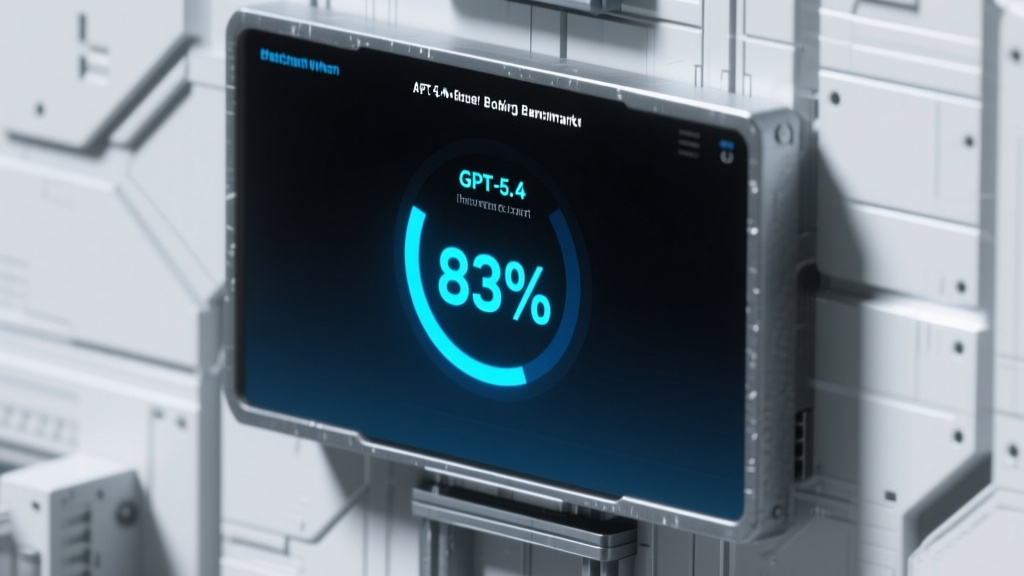
Distinct scene — I chose the moment when the GPT-5.4 model is being benchmarked, with a striking 83% score displayed on a sleek, industrial-style📷 Photo by Tech&Space
- ★83% human outperformance in pro tests
- ★18% fewer errors, 33% fewer false claims
- ★OpenAI’s synthetic benchmarks vs. real-world gaps
OpenAI’s latest model, GPT-5.4, has reportedly clobbered humans by 83% in professional-level work tests—a stat that sounds impressive until you remember who’s writing the scoreboard. The company claims an 18% reduction in errors and 33% fewer false claims compared to GPT-5.2, numbers that land with a thud in an industry already drowning in synthetic benchmarks. The real question isn’t whether GPT-5.4 is better, but whether these improvements translate beyond the lab—or if they’re just another iteration of AI’s favorite parlor trick: optimizing for metrics that advantage the vendor.
The pattern is familiar: OpenAI releases a new model, touts dramatic gains, and the tech press echoes the hype before anyone asks the critical question: What problem is this actually solving? The 83% human outperformance figure, for instance, comes from tests designed by OpenAI itself—hardly an impartial referee. Synthetic benchmarks, while useful for internal iteration, often fail to capture real-world friction, from ambiguous inputs to edge cases that break even the most polished models. The gap between demo and deployment remains vast, and OpenAI’s latest numbers do little to bridge it.
For developers, the improvements are tangible but incremental. Fewer errors and false claims suggest better fine-tuning, but without transparency on the dataset or evaluation methodology, it’s hard to gauge how much of this progress is genuine advancement versus clever prompt engineering. The GitHub repos and technical forums are buzzing, but the conversation is laced with skepticism. Developers aren’t just asking can GPT-5.4 do this—they’re asking will it, under real-world conditions, with messy data and unpredictable users.
Ultra-macro close-up of a 3mm microchip wafer (etched with 'GPT-5.4') delicately placed atop a crisp, unfolded $100 bill, both centered in the frame.📷 Photo by Tech&Space
The hype filter: what OpenAI’s numbers actually reveal—and conceal
The competitive implications are clearer. OpenAI’s relentless benchmarking arms race pressures rivals like Anthropic, Google, and Meta to keep pace, lest they cede ground in the AI marketing wars. Yet, for end-users—especially enterprises—these numbers are abstract until they translate into cost savings, reliability, or entirely new capabilities. The 33% drop in false claims is promising, but hallucinations remain a persistent thorn, and no amount of marketing can wish them away.
The real signal here isn’t the benchmark; it’s the shrinking room for error. As AI models proliferate, the bar for meaningful differentiation rises. OpenAI’s latest release doesn’t just need to outperform GPT-5.2—it needs to justify the compute costs, the fine-tuning overhead, and the ongoing trust deficit with a public growing weary of AI’s limitations. The developer community is watching closely, but their reactions are measured. There’s no rush to rewrite pipelines based on numbers alone, especially when the gap between demo and product remains a chasm.
For all the noise, the actual story is simpler: OpenAI is iterating faster than its competitors can match, but the benchmarks are increasingly detached from the realities of deployment. The winner in this round isn’t the user—it’s the marketing team. The real test will come when GPT-5.4 faces not a curated dataset, but the chaos of the real world. Until then, the 83% figure is just another data point in AI’s ongoing identity crisis: Are these tools improving, or are we just getting better at measuring them?